Sustainability at Green School: Walking the Talk
Green School serves as a model to local and international communities not only in how we educate our students about sustainability, but in how profoundly environmental concerns are integrated into our learning, philosophy, and daily lives.
Responsible Building
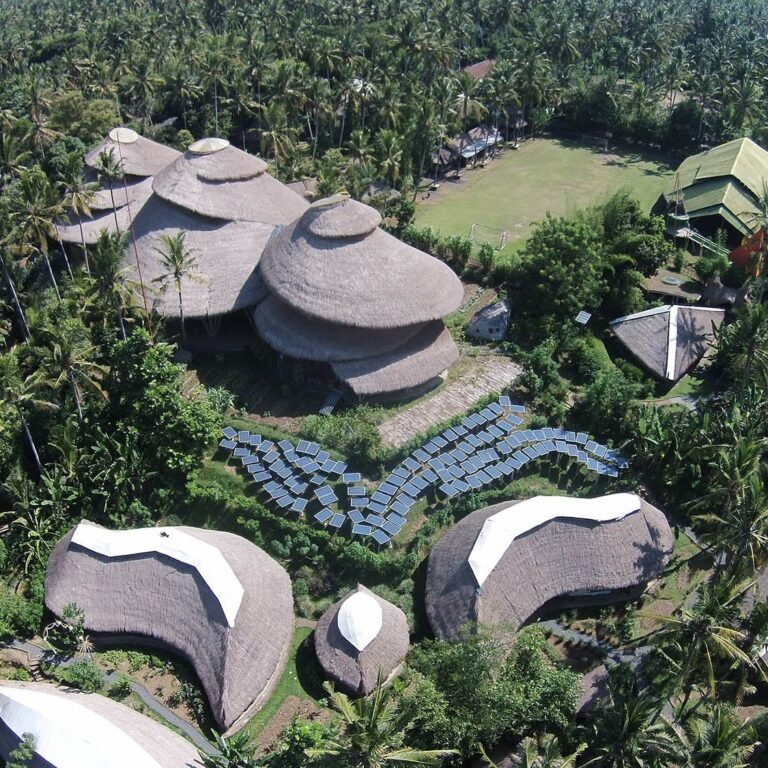
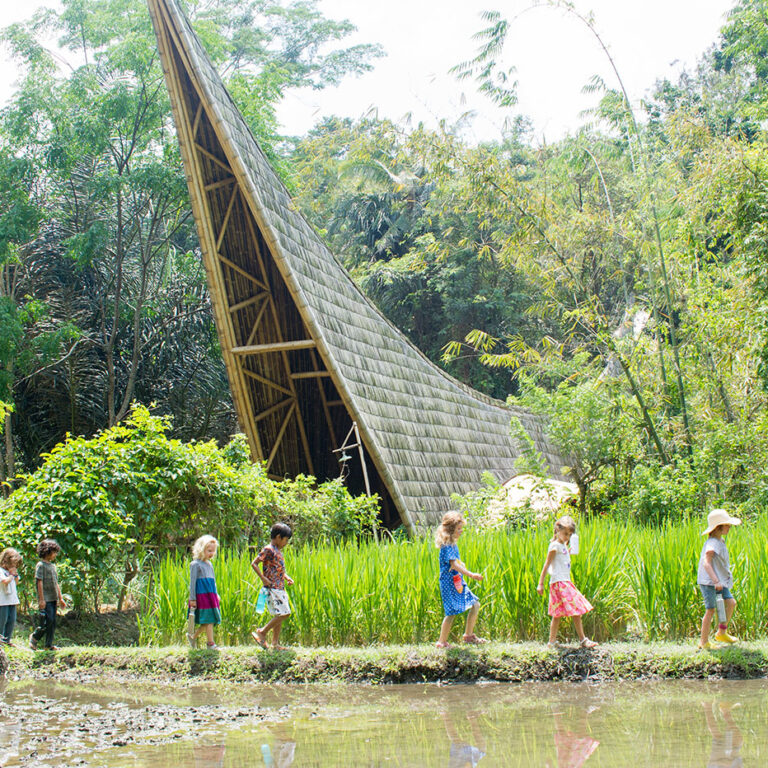
Every aspect of the site and buildings are living examples of sustainability: built on eight hectares of land straddling the Ayung River in Sibang Kaja, the School’s many buildings will cooled and powered by sustainable energy solutions including micro-hydro power, solar power, bio-diesel and predominantly natural air-conditioning. Indonesian bamboo, local alang-alang grass, traditional mud walls, and mud brick are used to construct classrooms, athletic facilities and other school buildings to minimize our use of non-sustainable materials such as concretes and plastics. Our goal is to use between 99 and 100 percent natural materials in our construction projects, to recycle as many materials as possible, and to manage our waste responsibly.
Generating Our Future
We strive to be as energy independent as we can. To that end, we are implementing an experiment in micro-hydro power generation, the nine-meter vortex generator. In addition, we are also producing methane from cow manure for fueling stoves, installing solar panels to supply permacultural projects, and developing a gasification unit that will use rice husks and other organic materials to produce electricity.
Sustaining Our Needs and Appetites
Our campus is blanketed by an organic permaculture system designed by international and local experts. Students engage in farming, which connects them to the land and what it offers, but also provides experiential learning applicable in the real world. The School’s gardens grow rice, fruits and vegetables that help to nourish the school community. Our agricultural land also produces fruits, vegetables, palm sugar and even chocolate from our own cacao trees—which are sold locally through entrepreneurial projects that students at the School will help to manage.
As another part of the experiential learning component at the School, our students are involved in growing and maintaining an edible maze; producing coconut oil from the trees flourishing across our campus; harvesting honey; and breeding fish in our aquaculture ponds, all with an aim to celebrate and take care of our campus’s remarkable natural abundance. Our composting systems are already in place and will continue to develop as more and more students, teachers, and staff move to the land.
Leg Work
Green School promotes alternative transportation both to and within the Kul-Kul Campus. One transportation initiative is a campus-wide co-operative bicycle program and trail network for school staff, faculty, and students. The project revolves around refurbishing discarded bicycles from the colonial era—rather than manufacturing new products—and converting them to hauling bikes equipped with bamboo trailers.
A network of bicycle paths will connect all campus facilities and link up to an extended network of existing and new trails in surrounding communities. Students and professional engineers will also design a bamboo bicycle while classroom assignments will help teach students how to build their own bikes using lessons that stem from math and science curricula. We are also in the process of designing and implementing a bio-gas-fueled buggy that will allow us to transport materials and people around campus.
Bridging Communities
The first structure completed on our campus was the elegant Kul-Kul Bridge suspended across the Ayung River. It soon became clear that not only would our students and faculty use this bridge to move through campus but that our neighbors would, too. Every day, hundreds of Balinese cross the bridge to attend temple, travel to a rice field, and head to work or school. Thus this beautiful span serves as an apt metaphor for what we believe to be true about sustainability: no program will make a real impact unless it is able to bridge cultures and embrace the weave of communities that surround and are integral to our campus. Our Balinese neighbors continue to be involved in our school not only as students, teachers, and parents, but as friends who are also committed to promoting and living within a framework of environmental responsibility.
To that end, we are educating local children about waste management and local schools are taking on projects to grow and maintain bamboo. We will soon be teaching English to community members and we are planning to sponsor a medical clinic, cultural center and other initiatives that show our respect and care for our neighbors. We are dedicated to providing a significant amount of scholarships to students from the local community so that our School fosters a diverse and vibrant mix of students from all nationalities.
Green Lab
We believe that if we are going to serve as a model of responsibility, Green School must be a nursery for ecologically friendly technologies and ideas. Every day, our students will be able to live within and think about environmental concerns in disciplines ranging from mathematics to current events. We will also sponsor pilot projects, such as testing plastic bags as materials with which to pave roads as well as other new recycling technologies. In addition, we are experimenting with ways to assess CO2 sequestration and to measure what we produce, with the intention of sharing our research with other companies, schools, and organizations interested in reducing and eliminating CO2 production.
Return to The Kul-Kul Campus